You don’t need to burn your closet and start again to be “ethical.” (Please don’t—landfills are already full.)
Why Tiny Swaps Beat Massive Overhauls
Shifting from fast-fashion hauls to thoughtful habits happens one small decision at a time. Think of these 10 swaps as sliders, not switches—you can move each one a little at a time, in a way that fits your life and budget.
1. Swap: Trend Chasing → Personal Uniform
Old pattern: Buying whatever is trending on TikTok or Instagram this week.
New habit: Discovering your own go-to “uniform.”
A personal uniform might look like:
- Black jeans + white tee + overshirt
- Midi dress + sneakers
- Wide-leg trousers + fitted top
Why it helps:
- Fewer “nothing to wear” crises.
- Less temptation to chase every new micro-trend.
- Easier to invest in pieces you’ll actually use.
Starter step: Notice your favorite outfit from the last month and write down its basic formula. That’s the seed of your uniform.
2. Swap: New Event Outfit → Repeat, Rent, or Borrow
Event coming up? Before ordering something new at 1 a.m., try:
- Repeating a favorite outfit (you’re allowed).
- Borrowing from a friend.
- Renting from a local shop or rental service.
Cost comparison (example):
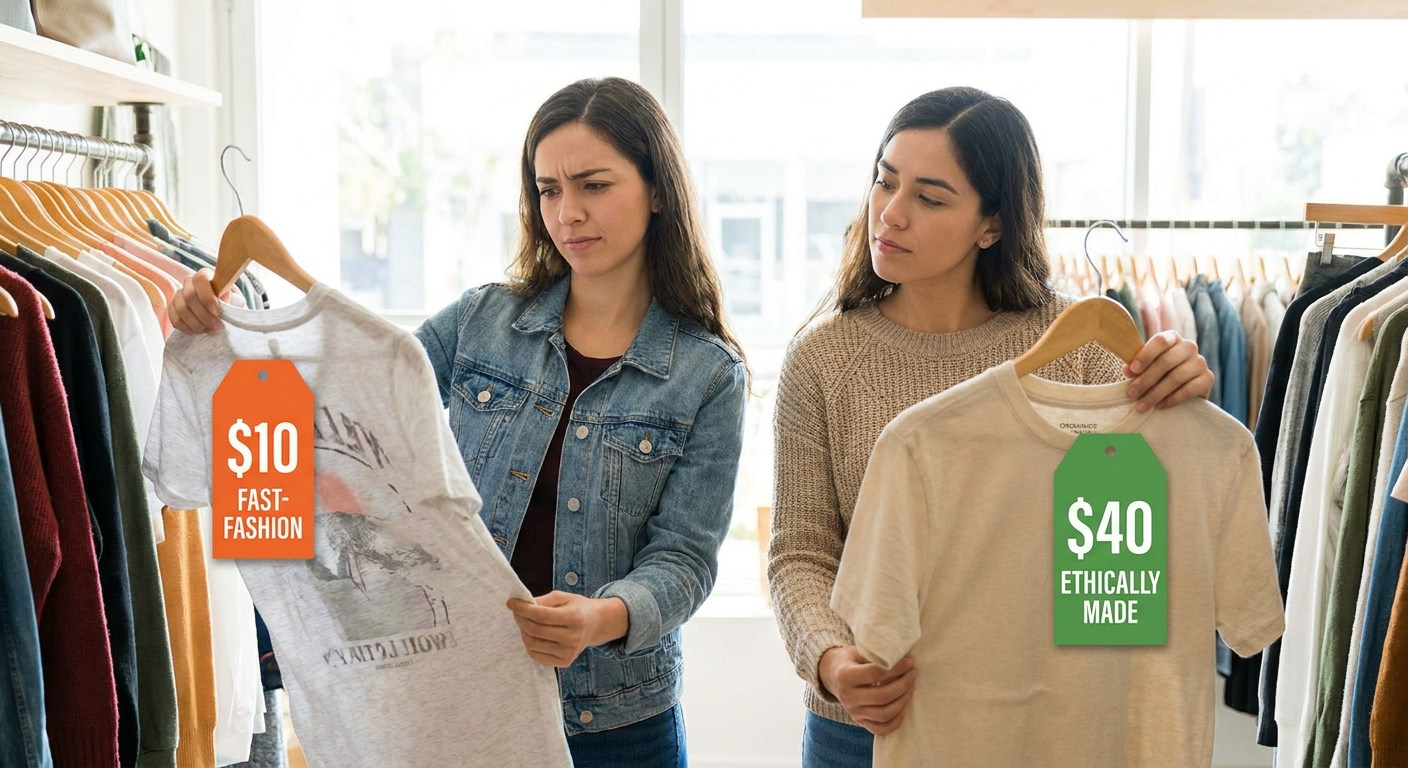
- New fast-fashion dress: $40–$70 (often worn once).
- Rental dress: $30–$60 (higher-quality, no long-term clutter).
- Borrowed: $0.
The planet doesn’t care if your outfit is “new”—only how much impact it took to make.
3. Swap: Sale Emails → Intentional Wish List
Constant sale alerts are designed to wear down your willpower.
Try this instead:
- Unsubscribe from 3–5 fashion mailing lists.
- Keep a running wish list on your phone for genuine wardrobe gaps (e.g., “black work pants,” “warm waterproof jacket”).
- When you do see a sale, check your list instead of browsing everything.
This channels your budget into what you actually need.
4. Swap: Fast Basics → Secondhand or Upgraded Staples
Basics (tees, jeans, sweaters) get the most wear. They’re worth an upgrade.
Options:
- Check thrift stores first for denim, coats, knitwear.
- Buy higher-quality new basics if you can (better fabric, better stitching).
Cost comparison (example jeans):
- Fast-fashion jeans: $25–$40 (often stretch out, fade fast).
- Thrifted premium-brand jeans: $15–$35.
- Ethical-brand jeans: $90–$150.
If ethical brands are out of reach, thrifted premium brands are a powerful middle ground.
5. Swap: “Dry Clean Only” → Machine-Washable (Mostly)
Special-care clothes often sit unworn—or rack up cleaning bills.
When possible, choose:
- Cotton, linen, TENCEL™, and some wool knits that can be hand-washed.
- Clothes with clear, realistic care tags.
Why it’s more ethical:
- You’ll actually wear them more.
- Fewer harsh chemicals and trips to the dry cleaner.
- Lower lifetime cost.
Beginner step: Next time you’re about to buy something, read the care label before the price tag.
6. Swap: Cheap Jewelry → A Few Quality Pieces
Fast-fashion jewelry often tarnishes quickly and can end up as trash.
Instead of buying five $8 necklaces over a year, consider:
- Saving for one $40–$60 piece you’ll wear constantly.
- Checking vintage or secondhand shops for real metals.
Cost comparison (one year):
- 5× $8 necklaces = $40, most unwearable by year’s end.
- 1× $50 necklace (stainless steel, silver, or gold-plated) = $50, still going strong.
Ethical fashion isn’t only about clothes; accessories count too.
7. Swap: “I’ll Fix It Someday” → One Simple Repair Skill
You do not need to become a sewing pro. Learning one or two tiny skills extends your clothing’s life massively.
Beginner-friendly repairs:
- Sewing on a button.
- Fixing a small seam split.
- Using iron-on patches inside jeans.
YouTube is full of 5-minute tutorials. Do this once, and suddenly “unwearable” becomes “back in rotation.”
Consider the cost:
- New jeans: $40–$120.
- Simple patch at home: a couple of dollars and 10 minutes.
- Tailor repair: $10–$25.
Even paying a tailor is often cheaper—and more ethical—than buying new.
8. Swap: Polyester Everything → Slowly Adding Better Fabrics
You don’t have to throw out your synthetics. Just upgrade gradually.
When you’re replacing or adding something, check the tag and:
- Aim for >50% natural fibers (cotton, linen, wool, hemp, TENCEL™).
- Prioritize natural-fiber pieces for items that touch your skin a lot (tees, underwear, socks).
Why it matters:
- Fewer microplastics shed in the wash.
- Usually better comfort and breathability.
- Often longer-lasting.
Remember: this is a tuning dial, not a purity test.
9. Swap: Constant “New” → Seasonal Refresh Days
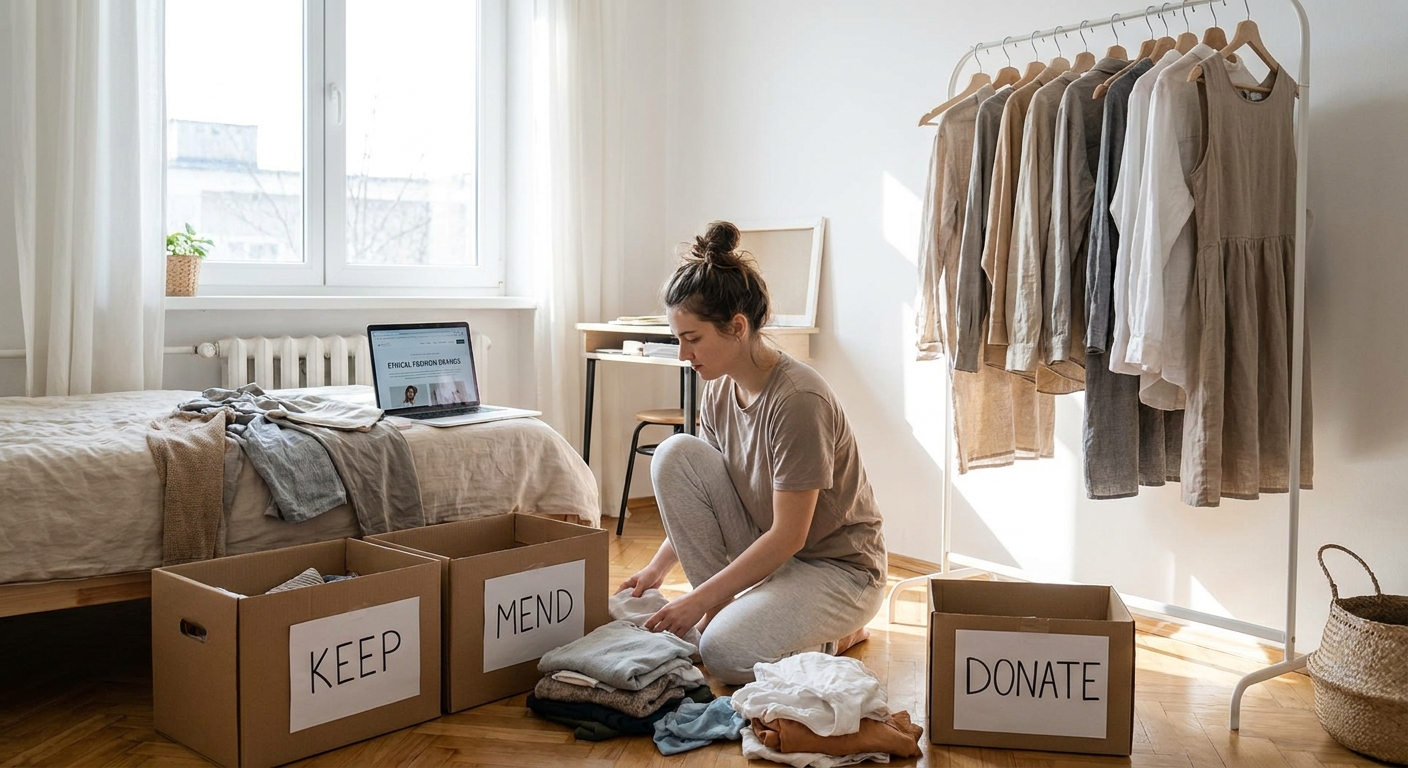
Instead of little shopping hits every week, try dedicated “refresh days” once or twice a year.
Process:
- Empty your wardrobe section by section.
- Fix missing buttons, lint-roll, de-pill sweaters.
- Make a realistic list of gaps (e.g., “summer sandals, black hoodie,” not “entire new personality”).
Then shop intentionally: secondhand first, then ethical brands as your budget allows, and only if you still need the item.
This rhythm makes fashion feel less like a constant chase and more like a manageable routine.
10. Swap: All-or-Nothing Mindset → Progress-Over-Perfection
You will:
- Still buy the occasional fast-fashion thing.
- Have weeks where you impulse-buy out of stress.
- Keep pieces that aren’t perfectly ethical because they fit you and your life.
That’s normal.
If you zoom out and see that:
- A bigger portion of your closet is secondhand or long-lasting.
- You’re repairing instead of tossing.
- You’re thinking before buying…
…then you’re doing ethical fashion.
A Quick Recap You Can Screenshot
Here are the 10 swaps in one place:
Trends → Personal uniform
New event outfits → Repeat, rent, borrow
Sale emails → Intentional wish list
Fast basics → Thrifted or upgraded staples
High-maintenance care → Machine-washable (mostly)
Fast jewelry → Fewer quality pieces
“Someday fixes” → One repair skill
All synthetics → Gradually more natural fibers
Constant shopping → Seasonal refresh days
Perfection → Progress
You don’t need to do all of these at once. Pick one or two that feel easiest this month. Treat it like a low-pressure experiment, not a moral test.
Ethical fashion isn’t about being the “perfect sustainable person.” It’s about aligning your closet with your values slowly, in a way that still makes room for joy, comfort, and yes—those occasional late-night online orders you’re working on reducing.