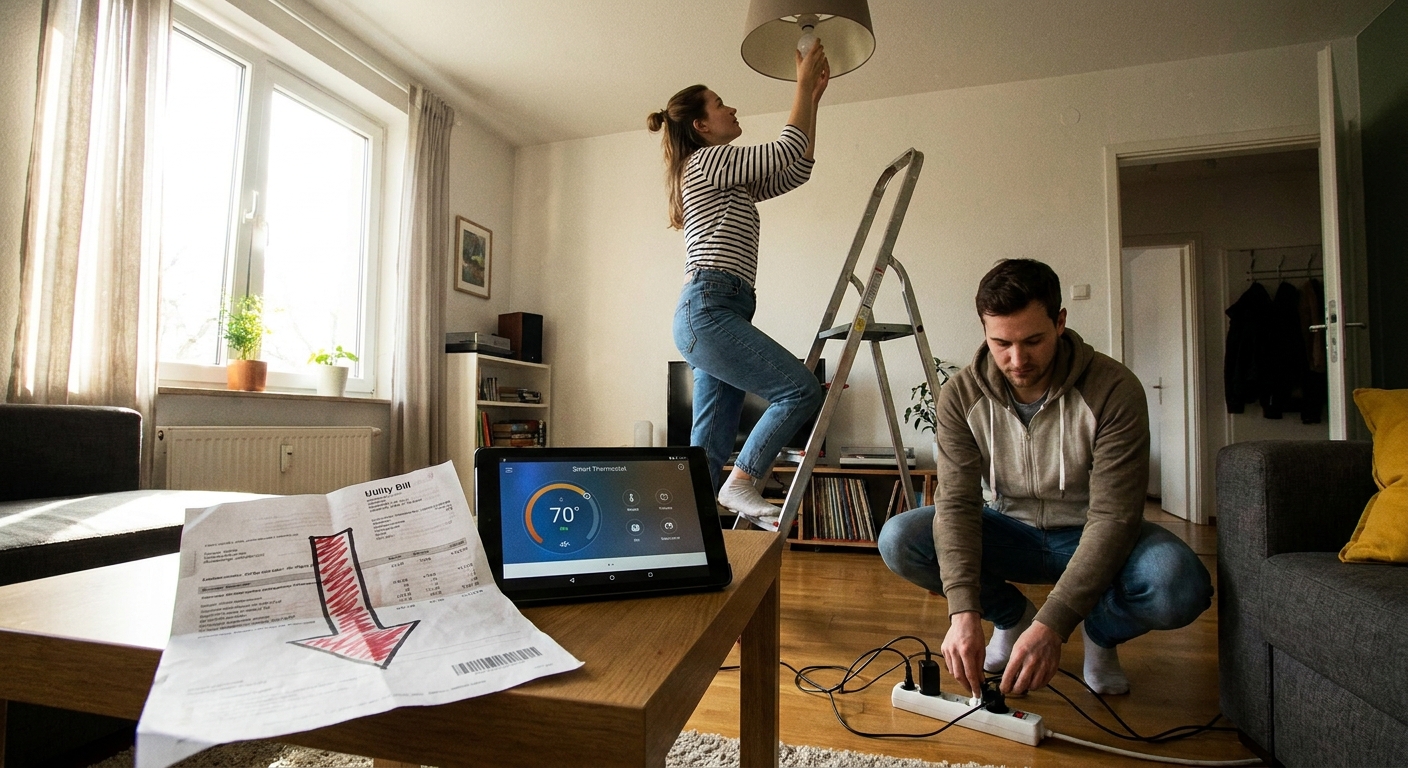
Most of us open our energy bill, squint at the total, wince, and then file it away—mentally and physically. If you’ve ever thought, “I want to use less energy, but I don’t even know where to start,” you’re not alone.
Why Your Energy Bill Feels So Confusing (and How to Fix That)
Let’s change that.
You don’t need to become an energy engineer. You just need to understand a few key numbers and how your habits connect to them. Think of this as a calm, honest walkthrough from a friend who also occasionally forgets to turn off the bathroom light.
Step 1: Decode the Basics on Your Bill
Grab your latest bill (paper or online) and look for three things:
1. Your Usage: kWh (Kilowatt-Hours)
- This is how much electricity you used in the billing period.
- It might be labelled “Usage,” “Consumption,” or “kWh used.”
1 kWh = using 1,000 watts for one hour (e.g., a 1,000W space heater for one hour).
2. Your Rate: Cost per kWh
- Look for a number like $0.12/kWh, $0.18/kWh, etc.
- Some bills have tiered or time-of-use rates (different prices at different usage levels or times of day).
3. The Comparison Chart
Most bills include a little graph comparing your usage:
- This month vs last month
- This month vs the same month last year
Don’t stress about perfection here. Just notice: Is your trend up, down, or steady?
Step 2: Turn Big, Vague Numbers into Real-Life Actions
When your bill says, for example, 400 kWh for the month… what does that even mean?
Let’s anchor it with common examples:
- Old fridge: ~80 kWh/month
- Modern efficient fridge: ~30–40 kWh/month
- TV (4 hours/day): ~10–20 kWh/month
- Washing machine (4 loads/week, warm): ~5–10 kWh/month
- Electric dryer (4 loads/week): ~40–60 kWh/month
- Electric water heating for a household: 80–150 kWh/month
You don’t need exact numbers. What matters is this: heating, cooling, hot water, and large appliances are the main drivers.
Step 3: A Simple Home Energy Audit You Can Do in One Evening
No clipboards or fancy tools required—just curiosity and maybe a notepad.
1. Walk-Through: The Big 4 Questions
Go room by room and ask:
Is there anything on that doesn’t need to be? (lights, fans, chargers)
Is anything running inefficiently? (old bulbs, very old fridge, ancient space heater)
Are there drafts or temperature extremes? (near windows/doors; this affects heating/cooling use)
Are you heating/cooling or lighting empty spaces out of habit?
Write down 5–10 things that jump out. This is your personal energy to-do list.
2. Identify “Always On” Devices
Look for items that are always plugged in:
- Fridge, freezer
- Internet router, modem
- TV, game console, streaming box
- Microwave (for the clock, mostly)
- Smart speakers, chargers, printers
These can quietly add up to 5–10% of your bill.
Low-stress fixes:
- Keep essential things (fridge, router) always on.
- Put non-essentials (TV, game console, printer) on a power strip so you can turn them fully off together.
Step 4: Cost Comparisons That Help You Prioritize
When you’re starting out, it’s easy to obsess over tiny things (like unplugging your phone charger) and ignore big ones (like your thermostat). Here’s a rough cost comparison.
Assuming $0.15/kWh:
Phone Charger Left Plugged In
- Uses about 0.1–0.2W when not charging.
- Rough yearly cost: $0.20–$0.40.
Verdict: Not worth stressing about.
Old 60W Bulb vs 9W LED (3 Hours/Day)
- 60W incandescent: ~66 kWh/year → $10/year.
- 9W LED: ~10 kWh/year → $1.50/year.
Savings per bulb: Around $8–$9/year.
With 10 bulbs, that’s $80–$90 a year.
Thermostat Change: 1–2 Degrees
Let’s say heating and cooling cost you $600/year.
- Adjusting your thermostat by 1–2°C (2–3°F) can save 3–6%.
- That’s about $20–$40/year for tiny comfort changes.
Clothes Dryer vs Air Drying (Even Half the Time)
Electric dryer for a family: ~40–60 kWh/month → $6–$9/month.
If you air-dry half your loads:
- Save around $3–$4.50/month, or $36–$54/year.
Beginner version:
- Air dry just towels and fitness clothes, or hang one load per week.
- Use a drying rack instead of a full clothesline if space is tight.
Step 5: Build a Realistic Energy-Saving Plan (Not a Perfect One)
Take your bill, your notes from the home walk-through, and choose 3 focus areas for the next 3 months.
Example Plan for a Busy Household
- Lighting: Swap 6 most-used bulbs for LEDs.
- Cost: ~$18–$30 one time.
- Savings: ~$45–$55/year.
- Laundry: Wash in cold, reduce dryer use.
- Effort: Low–medium.
- Savings: ~$40–$70/year (depending on usage).
Heating/Cooling Habits:
- Nudge thermostat by 1–2 degrees. - Close doors, manage curtains/blinds to keep temperatures stable. - Savings: ~$20–$50/year.
Total: Around $100–$150/year with modest changes.
You don’t have to do it perfectly every time. The goal is direction, not flawless discipline.
Step 6: Track One Simple Metric
Instead of trying to remember every action, measure progress at the bill level.
Option 1: Compare Month to Month (Same Season)
Save your bills (or screenshots) and write down:
- kWh used
- Amount paid
Compare this January to last January, this July to last July. If you see a small drop—even 5–10%—that’s real progress.
Option 2: Weekly Meter Check (Extra Credit)
If you want to get a bit nerdy (in a good way):
- Pick a day and time each week.
- Write down your meter reading.
- Note any big changes in habits (“started air-drying clothes,” “heatwave, AC running a lot”).
You’ll start to see how your lifestyle affects your numbers—without obsessing.
Step 7: Permission to Be Imperfect
You might:
- Have weeks where the dryer runs nonstop.
- Spend a heatwave camped in front of the AC.
- Forget your careful plan and binge-stream with all the lights on.
None of this makes you a fraud.
The point isn’t to win an imaginary competition. It’s to gently shift your normal, everyday habits so that, over months and years, your energy use and bills trend downward.
Remember:
- Every action counts, even inconsistently done.
- You’re allowed to prioritize comfort sometimes.
- Choosing one or two meaningful changes beats chasing 50 tiny ones.
Read your bill, understand what it’s telling you, choose your next small step—and let the rest be a work in progress. That’s still sustainability. And it’s still enough.