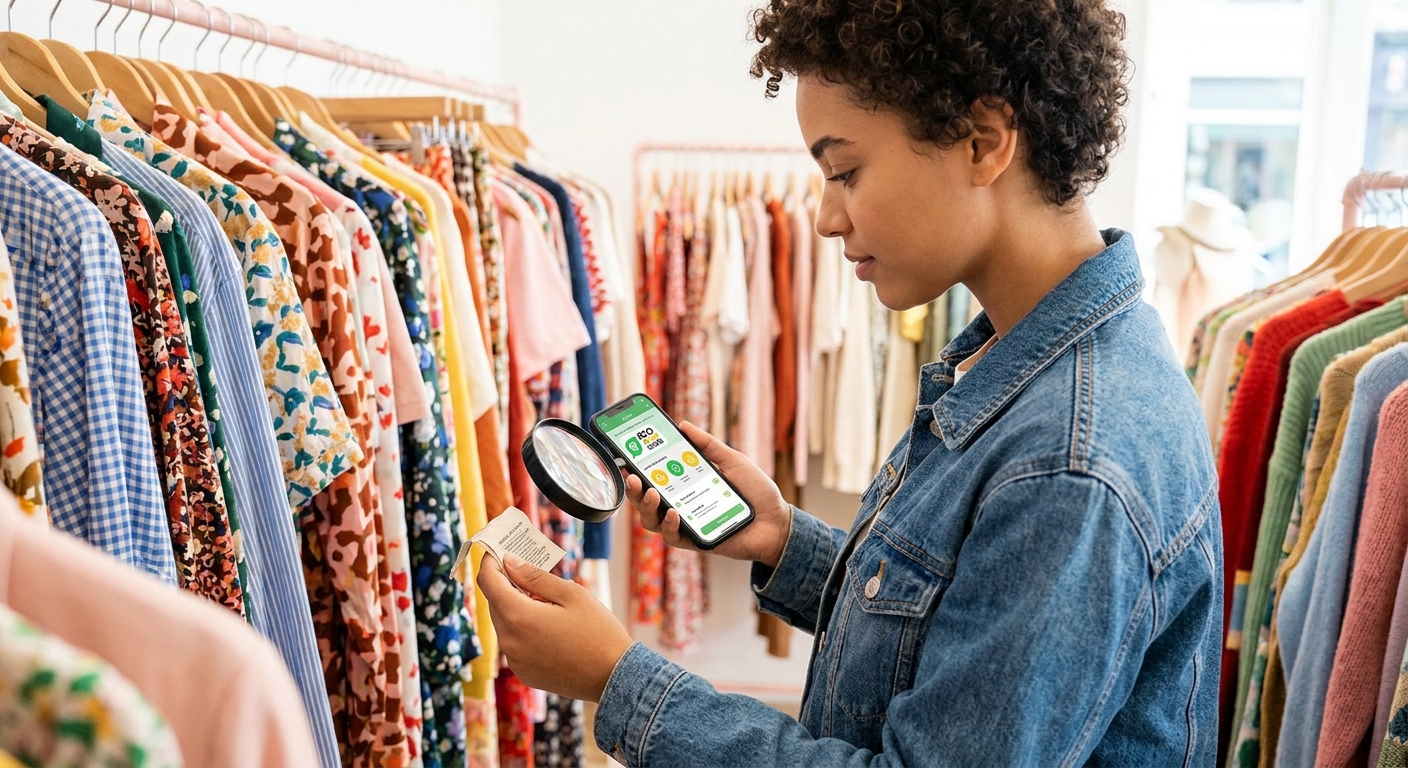
Most of us glance at the price tag and maybe the size, then toss the label aside. But those tiny tags carry big clues about how your clothes impact people and the planet.
Why Clothing Labels Matter (Even When They’re Itchy)
Learning to decode them doesn’t require perfection or a design degree—just a few simple habits. Think of this as leveling up your shopping skills, so you can make better choices when you’re able, and feel less overwhelmed when you’re not.
Step 1: Start With the Fiber Content Tag
This is usually a small white tag inside the side seam that lists percentages (e.g., 95% cotton, 5% elastane).
What You’ll See Most Often
- Cotton – Common, breathable, versatile.
- Polyester – Durable, cheap, made from fossil fuels.
- Elastane/Spandex/Lycra – Provides stretch, usually 1–10%.
- Viscose/Rayon – Semi-synthetic made from wood pulp; quality varies.
Beginner-Friendly Guideline
You don’t need to ban anything. Just ask:
For this type of item, is there a more durable or lower-impact fiber I could choose instead—without blowing my budget?
Examples:
- For basic T‑shirts, consider 100% cotton or a cotton blend over pure polyester.
- For summer clothes, look for linen, TENCEL™, or light cotton.
- For sweaters, try wool or cotton instead of 100% acrylic when you can.
This is about nudging, not policing.
Step 2: Check the Care Label for Real-Life Practicality
The care label tells you how to wash and dry the garment. This matters for ethics because clothes that are easy to care for get worn longer.
Ask:
- Will I realistically follow these care instructions?
- Do I have access to line-drying space / delicate cycle / hand-washing time?
If you’re a “toss it all in on cold and hope for the best” person (many of us are), then:
- Prioritize items that say machine wash cold.
- Be cautious with “dry clean only” unless it’s a piece you’ll wear for years (like a coat or blazer).
Well-cared-for clothing is more ethical, even if the brand itself isn’t perfect.
Step 3: Look for Country of Origin—Then Ask One Extra Question
The country of origin label (e.g., Made in Bangladesh, China, Italy) is often read as a moral verdict. It’s not that simple.
Uncomfortable truth:
- Low wages and poor factory conditions can happen in many countries, including wealthier ones.
- A country name alone doesn’t tell you if workers were paid fairly.
So instead of judging on country alone, pair it with one extra question:
Does this brand share any information about its factories or labor practices?
Check the brand’s website later (no pressure mid-shopping) for:
- Factory locations or partners.
- Any mention of living wages, independent audits, or safety standards.
- Certifications like Fairtrade, Fair Wear Foundation, or B Corp.
Even if you can’t avoid certain brands now, simply knowing what to look for is part of your ethical fashion journey.
Step 4: Spotting (and Surviving) Greenwashing
Greenwashing is when brands make something sound more sustainable than it is. Labels might shout:
- “Conscious collection!”
- “Eco line!”
- “Sustainably sourced materials!”
These words are meaningless without details.
More trustworthy signals:
- Specific material breakdown: “50% organic cotton, 50% recycled polyester.”
- Clearly stated standards: “GOTS-certified organic cotton,” “GRS-certified recycled polyester.”
- Details on how much of the entire collection is sustainable, not just one line.
Red flags:
- Vague phrases like “green,” “eco,” or “planet-friendly” with no backup.
- “We care about the earth” pages that never mention actual factories, audits, or worker protections.
You don’t have to boycott every greenwashing brand overnight. Just being able to mentally note, “Okay, this is mostly marketing,” helps you shop more consciously.
Step 5: Quick Material Swaps That Make a Difference
When you’re comparing two similar items and have the option, here are some simple upgrades:
T‑Shirts
- Instead of: 100% polyester
- Try: 100% cotton or cotton + a small amount of elastane
Sweaters
- Instead of: 100% acrylic
- Try: Wool/cotton blends, or at least a blend with some natural fiber.
Summer Dresses & Shirts
- Instead of: Heavy polyester that traps heat
- Try: Linen, cotton, or TENCEL™ blends.
Activewear
Here, synthetics are often necessary. Look for:
- Thicker, durable fabrics that won’t need replacing after a few months.
- Brands that offer repair or recycling programs, if available.
Again, you’re not failing if you choose the cheaper option—you’re practicing awareness.
Step 6: Use Labels to Estimate Longevity
Ethical fashion is also about buying fewer, better items. Labels can give you clues about how long something might last.
Signs of longer life:
- Medium-weight to heavier fabrics (not see-through thin unless they’re meant to be).
- A blend that balances structure and comfort (e.g., cotton with a touch of elastane).
- Natural fibers for items you’ll wear a lot.
Quick in-store tests:
- Hold it up to the light. Is it practically see-through when it shouldn’t be?
- Gently tug at a side seam. Does the stitching look tight and even?
- Lightly stretch it—is it springing back or staying warped?
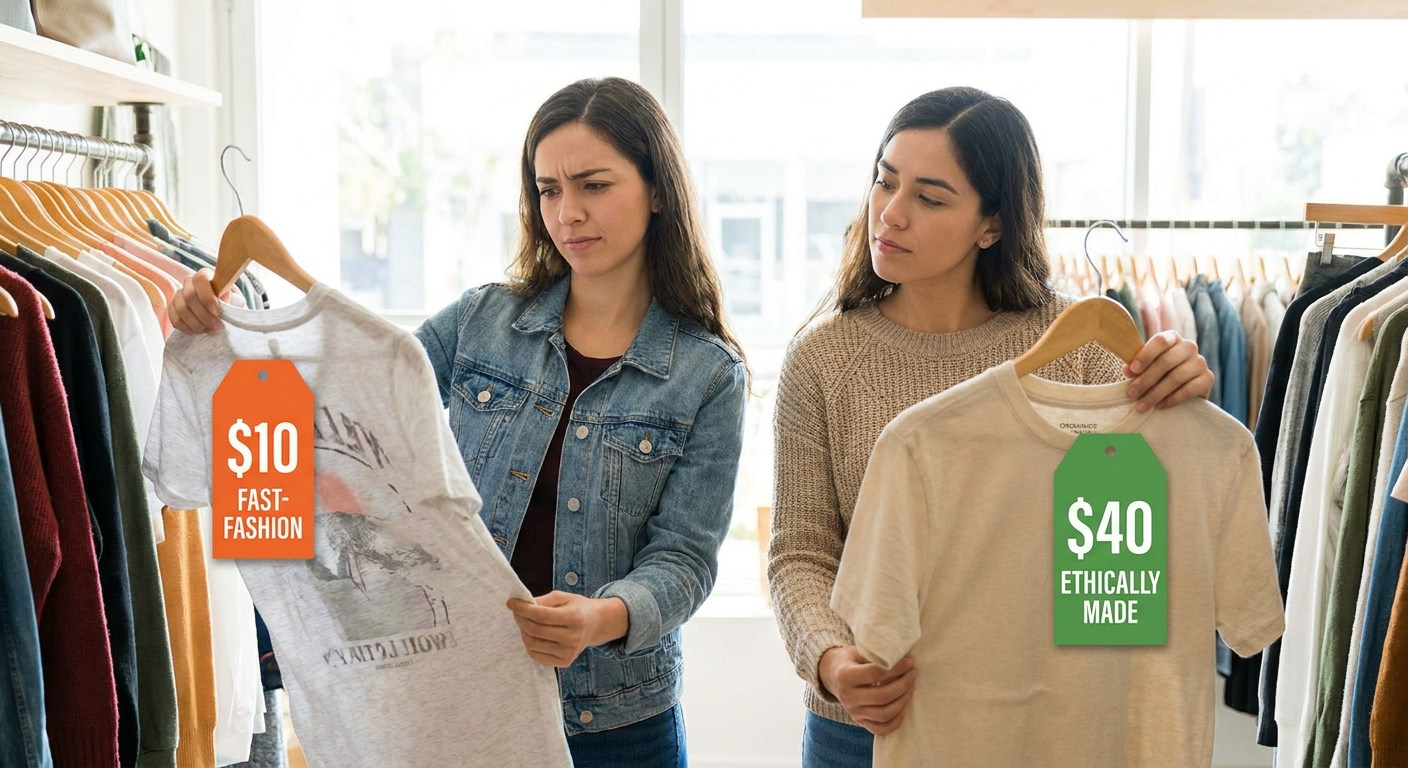
A $20 item that falls apart after 5 wears is more “expensive” per use than a $50 item that lasts 50 wears.
Step 7: Decide What Matters Most to You
Ethical fashion has many layers—fiber, water use, chemicals, labor rights, transport, longevity. No single tag will tick every box.
To avoid overwhelm, choose 1–2 priorities to focus on first, like:
- Comfort + longevity: Choosing breathable, long-lasting fibers.
- Worker rights (as far as you can tell): Supporting brands with any transparency.
- Microplastic reduction: Minimizing synthetic-heavy everyday basics.
As your budget, time, or energy changes, your priorities can evolve too.
Step 8: Be Kind to Yourself Between the Tags
There will be days when you:
- Grab the cheapest option because payday is far away.
- Buy something trendy because it makes you happy.
- Forget to check any labels at all.
That doesn’t erase the progress you’re making.
Ethical fashion isn’t a test you pass or fail based on your last receipt. It’s a practice—like composting most of the time but still ordering takeout in plastic containers when you’re tired.
If you start:
- Reading fiber content more often,
- Considering care instructions before buying,
- Pausing at greenwashed claims,
…you’re already miles ahead of where you were.
The goal isn’t to become a perfect ethical fashion detective. It’s to gather enough clues to make better-than-before choices, as often as your life allows.
And that is more than enough to matter.